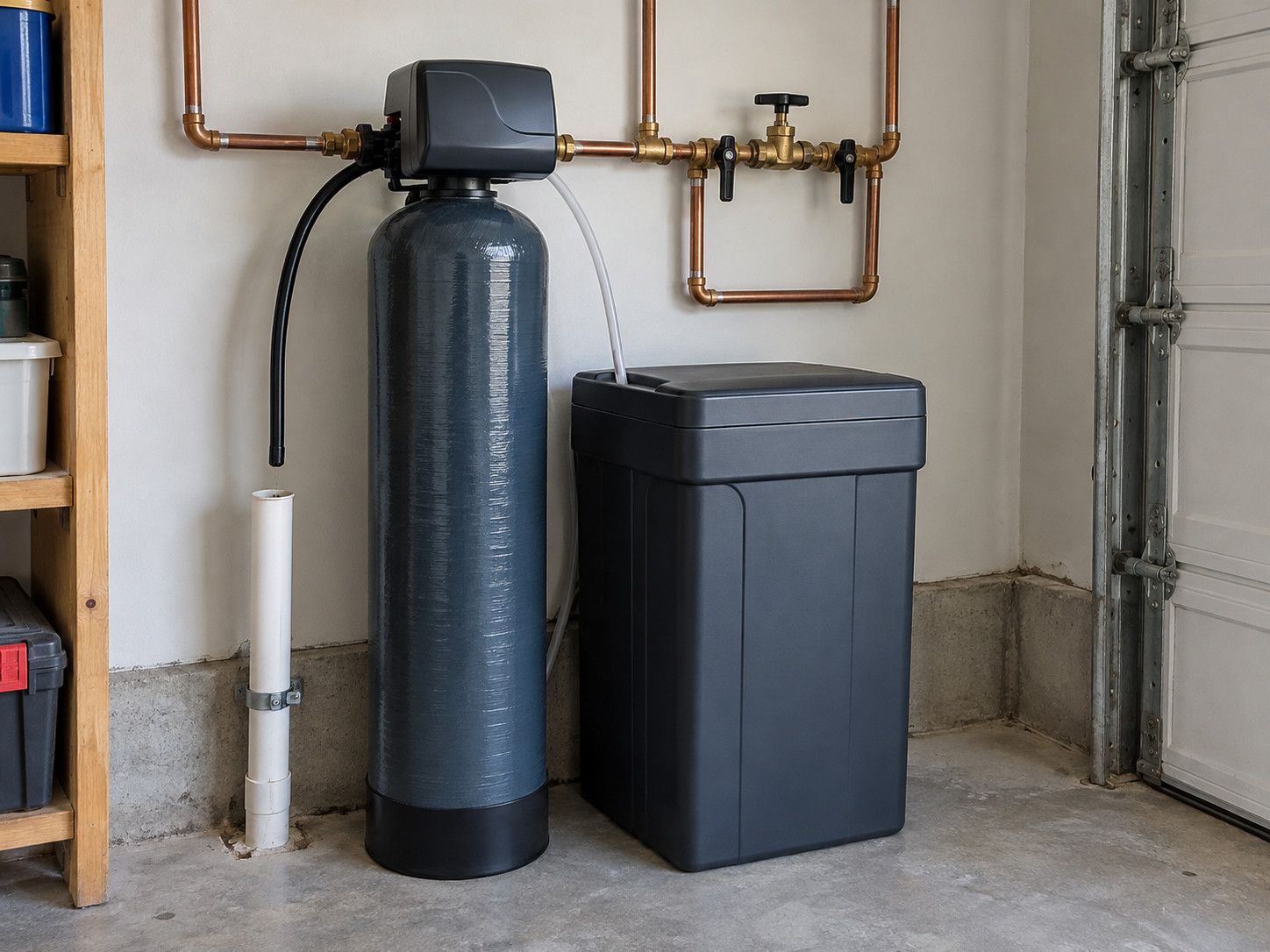
Test the hardness first
Hardness is the amount of calcium and magnesium dissolved in the water. Your utility's annual water quality report usually lists it; a well owner needs a test kit or a lab. The U.S. Geological Survey classifies it this way.
| Hardness, mg/L as calcium carbonate | USGS class | Grains per gallon, about |
|---|---|---|
| 0 to 60 | Soft | 0–3.5 |
| 61 to 120 | Moderately hard | 3.5–7 |
| 121 to 180 | Hard | 7–10.5 |
| More than 180 | Very hard | 10.5+ |
Source: U.S. Geological Survey, Hardness of Water. Grains per gallon converted at 17.1 mg/L per grain.
Sizing a softener in grains
Softeners are rated by how many grains of hardness they can remove before regenerating. A simple sizing estimate multiplies hardness in grains per gallon by the household's daily water use to get grains per day, then chooses a unit that regenerates every few days rather than every night. Iron in the water adds to the load, and many installers add a few grains of hardness for each part per million of iron. An oversized unit regenerates rarely and wastes little; an undersized one regenerates constantly and uses more salt and water.
What installation involves
- Location. Near the main line, after the main shutoff, before the water heater. Outdoor hose bibs are often left on hard water to save salt.
- Bypass valve. Lets the house run on untreated water during service.
- Drain. The regeneration discharge runs to a floor drain, laundry standpipe or other receptor, ending above it with an air gap or air break so drain water can't be drawn back into the softener.
- Power. Most control valves need an outlet.
- Brine tank. Sits beside the resin tank and holds the salt.
What it costs
| System | National range |
|---|---|
| Typical installed softener (average $2,500) | $1,100–$3,000 |
| Single-tank ion-exchange system | $650–$1,500 |
| Dual-tank ion-exchange system | $1,500–$3,000 |
Source: Fixr national softener guide, updated January 31, 2025.
Dual-tank systems keep one tank in service while the other regenerates, which suits large households and very hard water. The quote should list the unit's grain capacity, the plumbing materials, the drain arrangement and whether a new outlet is needed.
Softeners and water heaters
Hard water leaves scale in tank heaters and, faster, in tankless heat exchangers. Softening protects both, which is often the practical reason to install one. Scale also affects faucet cartridges and toilet fill valves. If a tankless unit is already reporting scale errors, it will need descaling whether or not a softener goes in; see tankless water heater installation for the maintenance side.
Local rules on salt
Every regeneration flushes salty brine into the sewer. Some communities, especially where wastewater is reused for irrigation, restrict or ban new salt-discharging softeners, and a few have required existing units to be removed. Check with your sewer district before buying. Where salt softeners are restricted, saltless conditioners or exchange-tank services that regenerate off site are the usual alternatives. Other kitchen and bath fixtures are covered on our plumbing fixture repair page.
Softener questions before you buy
Do I need a softener if my water is moderately hard?
It is a judgment call. USGS classes 61 to 120 milligrams per liter as moderately hard. At that level, scale on fixtures and in water heaters builds slowly; many households live with it, and others soften mainly to protect a tankless heater.
Is softened water safe to drink?
Ion-exchange softeners add a small amount of sodium, or potassium if you use potassium chloride. People on low-sodium diets often keep a separate unsoftened cold line to the kitchen tap.
What is a saltless water conditioner?
A device that changes how minerals behave, for example by forming crystals that are less likely to stick, rather than removing them. It doesn’t produce soft water in the ion-exchange sense, and results vary with water chemistry.
Where does the softener’s brine go?
Into a drain, through an air gap or air break so wastewater can’t flow back into the softener. Some communities restrict salt-discharging softeners because the salt ends up in reclaimed water; your sewer district can tell you.
Sources
- Water Softener Installation Cost, Fixr, updated January 31, 2025.
- Hardness of Water, U.S. Geological Survey Water Science School.
Reviewed September 27, 2026. Found an error? Write to admin@plumbingrepairquotes.com.