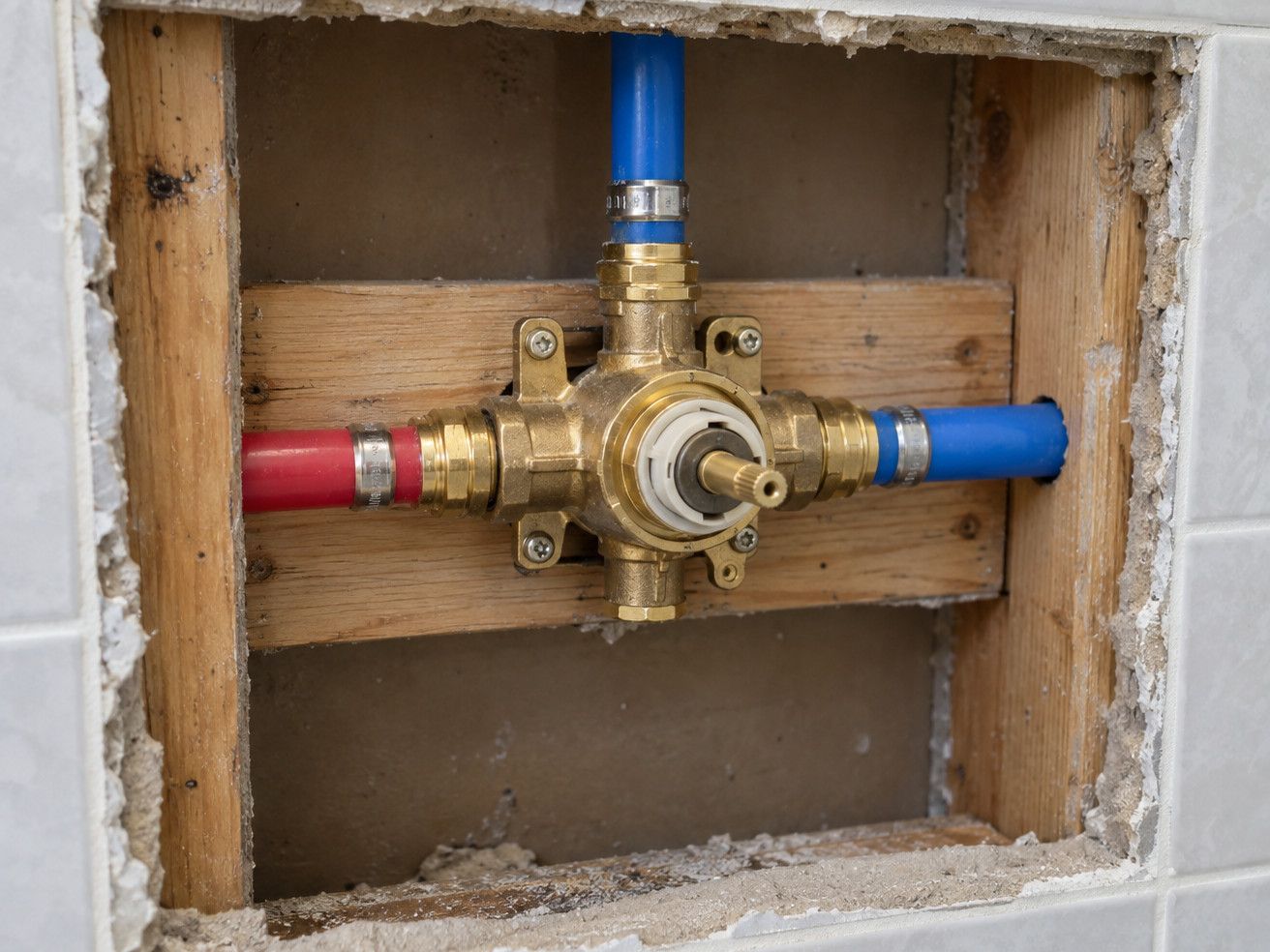
Cartridge or valve: how to tell
| Symptom | Usually |
|---|---|
| Dripping from the showerhead with the handle off | Cartridge or seals |
| Handle stiff, loose or hard to set | Cartridge |
| Temperature swings when another fixture runs | Pressure-balancing cartridge, or a valve without that function |
| No hot water at this shower only | Cartridge, or the limit stop set too far |
| Water inside the wall or on the ceiling below | Valve body or its connections |
| Cartridge for this valve no longer available | Valve |
The anti-scald requirement
A modern shower valve does more than mix hot and cold. The International Plumbing Code (IPC 2021 §412.3) requires shower control valves to meet ASSE 1016/ASME A112.1016/CSA B125.16 or an equivalent standard, which covers pressure-balancing and thermostatic valves, and to have a means of limiting the maximum setting to 120°F. The reason is scald injuries. The Consumer Product Safety Commission's figures for a third-degree burn:
| Water temperature | Exposure time |
|---|---|
| 150°F | 2 seconds |
| 140°F | 6 seconds |
| 130°F | 30 seconds |
| 120°F | 5 minutes |
Source: U.S. Consumer Product Safety Commission, Publication 5098.
An older two-handle shower without pressure balancing works until someone flushes a toilet. Replacing it with a compliant valve is the usual reason the whole valve gets replaced at all.
Replacing the cartridge
With the water off at the stops or the main, the plumber removes the handle and trim, pulls the retaining clip or nut, and slides the old cartridge out. A matching cartridge goes in, the limit stop is set, and the trim goes back. The job takes an hour or so when the right part is in hand, which is why a photo of the trim and any markings is worth sending before the visit.
Replacing the valve body
Replacing the valve means reaching the pipes behind the finished wall. From an access panel on the other side of the wall, that is straightforward. From the shower side, the tile around the valve has to be cut, and the opening is covered with an oversized trim plate or new tile. The new valve is connected with soldered, press or PEX fittings, pressure-tested before the wall is closed, and set to the 120°F limit.
What it costs
| Job | National range |
|---|---|
| Cartridge replacement | $100–$300 |
| Full valve, replaced | $200–$650 |
| Leaky shower faucet or valve, all causes | $100–$750 |
Source: Fixr, Cost to Repair a Shower (leaky faucet and valve), updated January 31, 2025. Tile work beyond a trim plate is extra.
Sink and tub faucets have their own designs, covered on our faucet repair page. If hot water is missing everywhere, the shower valve isn't the cause; start at no hot water instead.
Shower valve questions
Can a shower valve be replaced without removing tile?
Often, if there is an access panel behind the shower or the old valve’s trim plate is large enough to cover a small opening. Otherwise the tile around the valve has to be cut, and an oversized trim plate can cover the repair.
Why does my shower turn cold when someone flushes?
The valve isn’t balancing pressure. Code-compliant valves balance or control temperature automatically; an old two-handle valve without that function, or a failed pressure-balancing cartridge, lets the temperature swing.
How hot should the shower be able to get?
IPC 2021 §412.3 requires shower valves to have a means of limiting the maximum setting to 120°F. CPSC figures show that at 120°F, a third-degree burn takes about five minutes, against six seconds at 140°F.
Do I need a permit to replace a shower valve?
Replacing a valve inside the wall usually needs one, because the code’s permit exemptions stop at repairs that don’t replace valves or pipes. Swapping a cartridge is a repair and usually doesn’t.
Sources
- Cost to Repair a Shower (leaky shower faucet and valve), Fixr, updated January 31, 2025.
- International Plumbing Code 2021, Chapter 4: Fixtures, Faucets and Fixture Fittings (§412.3, shower valves), International Code Council.
- Avoiding Tap Water Scalds, Publication 5098, U.S. Consumer Product Safety Commission.
- International Plumbing Code 2021, Chapter 1: Scope and Administration (§106.2, work exempt from permit), International Code Council.
Reviewed September 27, 2026. Found an error? Write to admin@plumbingrepairquotes.com.