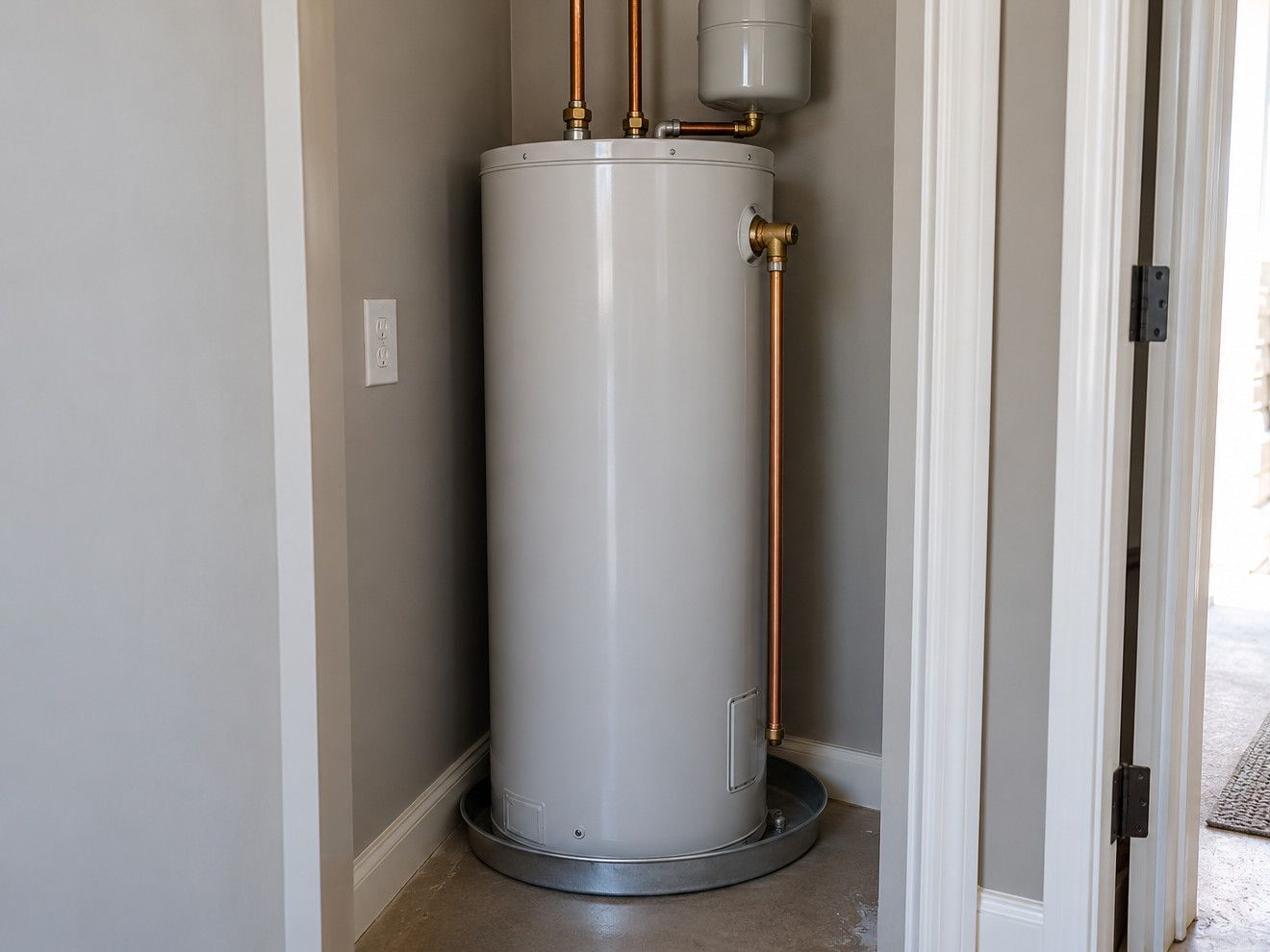
Which part failed? Start with the symptom
Plumbers diagnose by symptom first and by fuel second, because the same complaint points to different parts on gas and electric heaters. Find the row that matches what you see, and you will know roughly what the visit is about before anyone arrives.
| What you notice | Gas heater: usual cause | Electric heater: usual cause |
|---|---|---|
| No hot water at all | Pilot out, weak thermocouple or thermopile, gas valve, or the igniter on power-vent models | Tripped breaker, tripped high-limit switch, failed upper element or thermostat |
| Hot water runs out quickly | Sediment on the tank floor, broken dip tube, tank too small for the household | Failed lower element or thermostat, sediment, broken dip tube |
| Rumbling, popping or knocking | Sediment layer boiling under the burner | Scale crusted on the lower element |
| Rotten-egg smell from hot taps only | Bacteria reacting with the magnesium anode | Same |
| Relief valve pipe dripping | Thermal expansion, high supply pressure or a worn valve | Same |
Symptom-to-part matches follow standard service diagnosis. Confirm on site before buying parts.
If the heater makes no hot water at all, our step-by-step page on no hot water in the house walks through the checks in the order a technician makes them. Water on the floor is a separate problem with its own guide: finding a water heater leak.
What the common fixes cost
Fixr's national cost guide, updated in August 2025, puts the average visit at about $450, with most jobs between $150 and $750 including labor. The part is usually the smaller share. The trip, the diagnosis and the time to drain, refill and test the tank make up most of the bill.
| Repair | National range, installed |
|---|---|
| Thermostat | $100–$250 |
| Temperature and pressure relief valve | $100–$250 |
| Thermocouple (gas) | $150–$325 |
| Gas control valve | $150–$300 |
| Heating element (electric) | $200–$750 |
| Typical repair overall (average $450) | $150–$750 |
Source: Fixr national repair cost guide, updated August 29, 2025. National figures; local labor rates move them in both directions.
Repair or replace: four questions that decide it
- Is the tank leaking? Then the question is settled. Steel that has rusted through can't be patched, only replaced.
- How does the quote compare with a new heater? Fixr's installation guide, updated January 2026, puts a typical tank replacement at about $1,400 installed. A $500 control on an old heater buys time; it doesn't buy a new heater. Our water heater replacement cost page breaks that number down.
- How old is it? The manufacture date is coded into the serial number on the rating plate. The maker's website or support line decodes it. Set the age against the tank warranty printed on the same plate.
- Would the work trigger code upgrades anyway? Replacing a heater usually needs a permit, and the inspector will look for a thermal expansion device where the supply has a check valve or regulator (IPC 2021 §607.3), a correct relief valve discharge pipe (§504.6) and, where a leak would cause damage, a pan (§504.7). If those items are missing, the replacement quote will include them.
Gas heaters: pilot, thermocouple, gas valve and venting
On a standard gas heater, a thermocouple, or a thermopile on some models, proves to the gas valve that the pilot is lit. When it weakens, the pilot won't stay on after you release the knob, which is the most common no-heat call on older gas units. Newer atmospheric models add a flammable-vapor sensor that shuts the burner down if it detects fumes, and it can lock out after a spill of paint thinner or gasoline nearby. Power-vent models need electricity for the fan and the igniter, so they stop during a power outage.
If you smell gas
Leave the house without switching lights or appliances on or off, and call the gas utility or 911 from outside. A gas leak is the utility's emergency first, and a plumber's job second.
Heaters in garages carry one more rule. Under the International Fuel Gas Code (IFGC 2021 §305.3), an appliance with an ignition source must sit with that source at least 18 inches above the garage floor unless it is listed as flammable-vapor-ignition-resistant. A replacement in a garage often means a new stand.
Electric heaters: elements, thermostats and the reset button
Most household electric tanks have two heating elements, each with its own thermostat, plus a high-limit switch with a red reset button behind the upper access panel. The upper element heats first; if it fails, the tank makes no hot water at all. When the lower one fails, the heater still produces a little hot water, which runs out fast.
Two cautions before anyone opens a panel: switch off the breaker, because the terminals carry 240 volts, and never restore power to an element in a tank that isn't full. An element energized in air burns out within seconds, and that turns a $250 repair into a second one.
Tankless units: scale, sensors and error codes
A tankless heater fails differently. Hard water leaves scale in its heat exchanger, and the unit reports it with an error code long before it quits; descaling with a pump and vinegar or a manufacturer's solution is routine maintenance. Flame sensors, igniters and flow sensors are the usual replaceable parts. Tankless water heater installation covers gas line and venting requirements, which matter for repairs too.
Maintenance that heads off repairs
A 2001 Department of Energy fact sheet on water heating recommends three habits that still hold: flush a quart of water from the tank every three months, check the temperature and pressure relief valve every six months, and inspect the anode rod every three to four years. Set the thermostat to 120°F, which is what the Consumer Product Safety Commission recommends to prevent scalds, and keep storage clear of the burner on gas models.
Guides to specific water heater problems
- Water heater replacement cost
Tank size, fuel, venting and code upgrades that set the installed price.
- Tankless water heater installation
Gas line, venting, flow rate and the real cost of switching from a tank.
- Heat pump water heater
Space, power and drain requirements, savings, and the 2029 federal standard.
- No hot water
Pilot, burner, elements and breakers: the order a plumber checks them.
- Leaking water heater
Relief valve, drain valve, fittings or a failed tank, and what to shut off first.
- Water heater size
First-hour rating for tanks, gallons per minute for tankless, by household.
Water heater questions we hear often
How long does a repair visit take?
Most part swaps take one to two hours on site, and a good share of that is draining and refilling the tank. Waiting for a gas control valve or a model-specific board can add a day or two.
Can I replace a thermocouple myself?
Plenty of homeowners do. The job involves the gas supply and the burner, though, so if you are not comfortable relighting a pilot and checking a fitting for leaks with soapy water, leave it to a plumber. Some jurisdictions require a permit for any work on gas piping.
Why does my hot water smell like rotten eggs?
When the smell comes only from hot taps, bacteria in the water are usually reacting with the magnesium anode rod and producing hydrogen sulfide. Plumbers typically swap the anode for an aluminum-zinc one and disinfect the tank. If cold water smells too, the source is the water supply, not the heater.
Is it worth fixing a 12-year-old heater?
A low-cost part on a dry tank, usually yes. An expensive control or element on a tank that old, usually no. Put the repair quote next to the installed price of a new heater and the warranty term on the rating plate, and the answer tends to be obvious.
Sources
- Water Heater Repair Cost, Fixr, updated August 29, 2025.
- Water Heater Installation Cost, Fixr, updated January 27, 2026.
- International Plumbing Code 2021, Chapter 5: Water Heaters (§504.4, §504.6, §504.7), International Code Council.
- International Plumbing Code 2021, Chapter 6: Water Supply and Distribution (§604.8, §607.3, Table 604.3), International Code Council.
- International Fuel Gas Code 2021, Chapter 3 (§305.3, ignition sources in garages), International Code Council.
- Avoiding Tap Water Scalds, Publication 5098, U.S. Consumer Product Safety Commission.
- Technology Fact Sheet: Water Heating (DOE/GO-102001-0785), first-hour rating worksheet, U.S. Department of Energy, August 2001.
Reviewed September 27, 2026. Found an error? Write to admin@plumbingrepairquotes.com.