Why copper pits from the inside
Copper protects itself with a thin oxide film on the inside of the pipe. Pinholes form where that film breaks down in one small spot and corrosion concentrates there, drilling a pit through the wall while the pipe around it stays sound. Four conditions are usually behind it.
- Water chemistry. pH, disinfectant, dissolved oxygen and minerals all affect whether the protective film holds. Pinholes often cluster by neighborhood for this reason.
- Flow speed. Water moving too fast, as in hot-water recirculation loops and undersized pipe, wears the film away, especially just past fittings and elbows.
- Installation leftovers. Excess soldering flux left inside a joint, or burrs left on cut pipe ends, start corrosion at the fitting.
- Electrical current. Improper grounding or stray current on the water pipe can accelerate corrosion in places.
How a pinhole shows up
A fine spray or steady drip from a pipe, a stain spreading on a ceiling below a bathroom, a hissing sound in a wall, or a blue-green crust on a copper pipe where water has been seeping. Horizontal runs in basements and crawl spaces and the hot line near a water heater are common locations.
Stopping it until the plumber arrives
- Close the nearest valve, or the main water shut off valve if there isn't one.
- Wrap a pipe repair clamp around the pinhole, with its rubber pad centered on the hole, and tighten it. Epoxy putty rated for plumbing works on a dry pipe.
- Treat both as temporary. They hold pressure for days or weeks, not years, and they don't address the corrosion around the hole.
The permanent repair
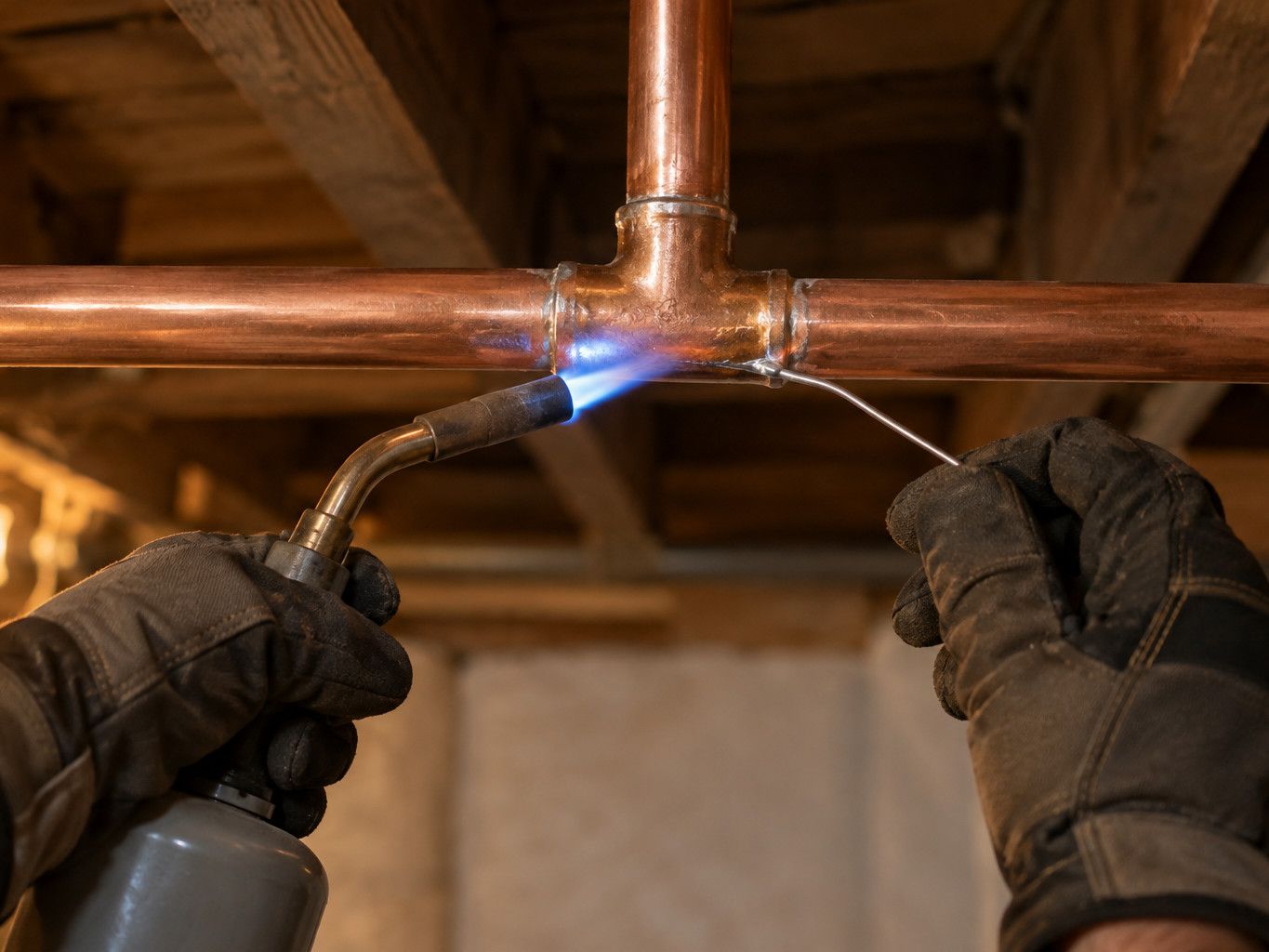
The plumber cuts out the damaged section, usually a few inches either side of the hole, and joins new pipe with soldered couplings, press fittings or push-fit fittings. The section they remove is worth looking at: if the inside is pitted along its length, more pinholes are coming. Replacement pipe, fittings and solder for drinking water must meet the federal lead limits, a weighted average of 0.25 percent lead on wetted surfaces and 0.2 percent in solder and flux, according to EPA.
What a pinhole repair costs
We haven't found a national cost guide for pinhole repairs specifically. The closest published figures are for burst pipes: Fixr's burst pipe guide, last updated August 19, 2022, puts a typical repair at about $500, within a $200 to $1,000 range, and $150 to $250 per linear foot where a section is replaced. A pinhole in an exposed basement pipe usually sits at the low end; one inside a finished ceiling adds opening and patching drywall. Our burst pipe repair page covers larger failures.
When pinholes mean it is time to repipe
There's no fixed number, but plumbers start recommending a repipe when leaks repeat on different parts of the system, when the removed section shows pitting throughout, or when the leaks are inside finished walls and ceilings where every repair means opening a room. Fixr's October 2024 figures put a whole-house PEX repipe at $2,000 to $5,000 and copper at $5,000 to $20,000, which is why PEX is the usual choice when pinholes are the reason. Compare the options on our repipe cost page, and the detection methods for hidden ones on the leak detection page.
Pinhole questions owners ask
Is copper still a good choice for water pipe?
In most water it lasts a very long time, and it remains a standard material. Where local water chemistry has caused repeated pitting, plumbers often switch to PEX for repairs and repipes, because PEX doesn’t corrode.
Does a water softener cause pinhole leaks?
Not by itself in most systems. Some studies connect particular corrosion types to very soft or low-pH water, which is why a water test before and after installing treatment is sensible when pinholes have already appeared.
Is PEX immune to leaks?
PEX doesn’t pit, but it can fail at fittings, where it is exposed to sunlight, or where it is kinked or chewed. Its failures are different, not absent.
Should I have the water tested?
If you have had more than one pinhole, yes. Start with your utility’s annual water quality report, which lists pH and disinfectant; a plumber or lab can test the water at your tap for more.
Sources
- Burst Pipe Repair Cost, Fixr, updated August 19, 2022.
- Cost to Replace Lead Pipes in Homes (whole-house repipe by material), Fixr, October 3, 2024.
- Lead content limits for pipes, fittings, fixtures, solder and flux (Safe Drinking Water Act §1417), U.S. Environmental Protection Agency, updated May 19, 2026.
Reviewed September 27, 2026. Found an error? Write to admin@plumbingrepairquotes.com.