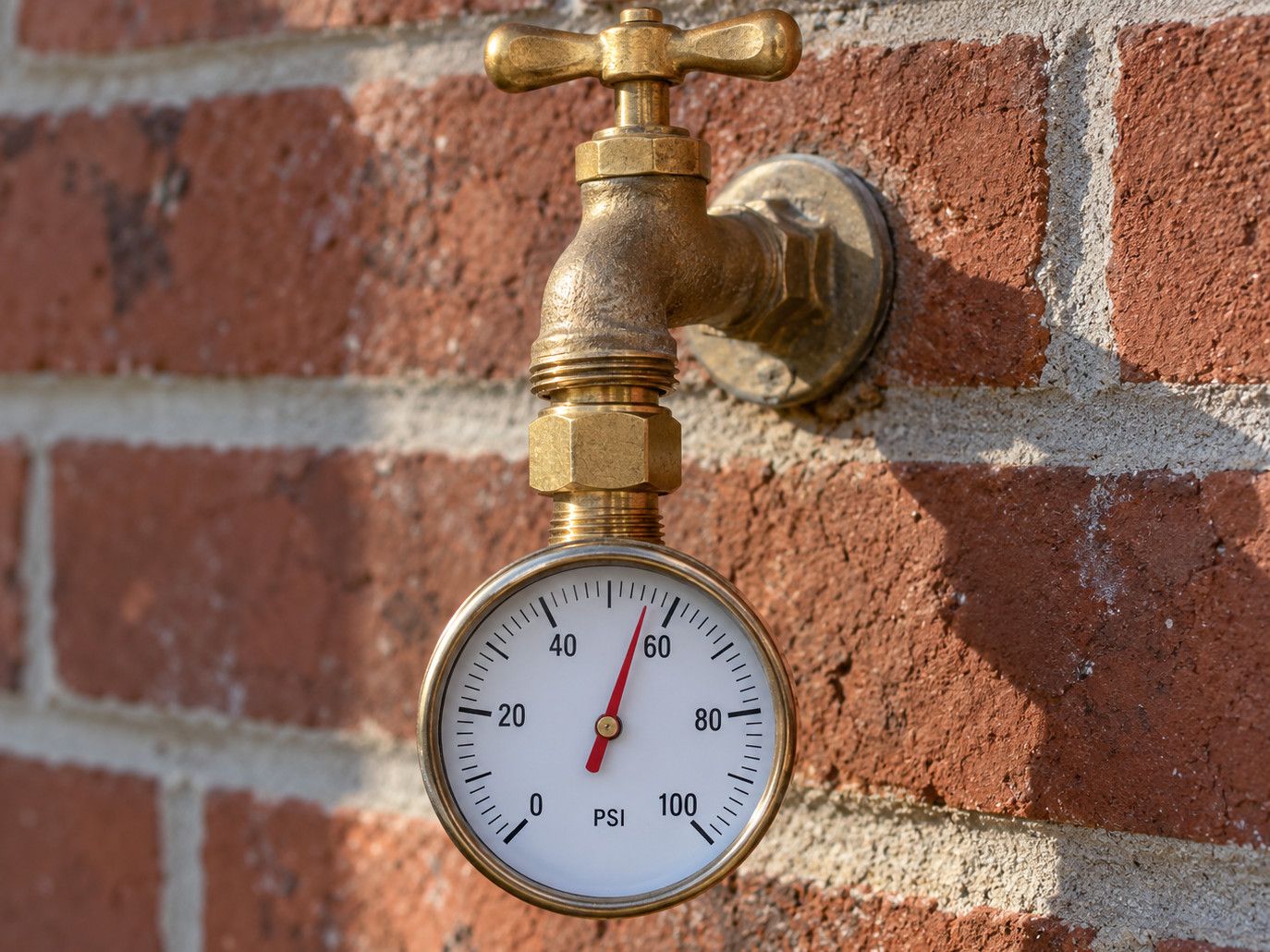
Measure the pressure first
A pressure gauge that screws onto a hose bib costs little at a hardware store and tells you more than any description. With every faucet off, it reads the static pressure. Open a faucet inside, and the needle drops to show pressure under flow; a big drop means a restriction or undersized pipe.
| Reading | What it means | Code reference |
|---|---|---|
| Static above 80 psi | Too high: a pressure-reducing valve is required | IPC 2021 §604.8; UPC 2021 §608.2 |
| Flowing at 8 psi or more at faucets and showers | Enough for most fixtures to work as designed | IPC 2021 Table 604.3 |
| Flowing at 20 psi or more at a tank toilet | Enough for the fill valve | IPC 2021 Table 604.3 |
Minimum flow pressures from IPC 2021 Table 604.3; local amendments may differ.
One fixture: aerators, cartridges and stops
When a single faucet runs weakly and the rest of the house is fine, the problem is almost always at that fixture. Unscrew the aerator at the spout and rinse out the grit and scale. If that doesn't help, check that the stop valves under the sink are fully open, then look at the faucet cartridge, which collects debris after water main work. A weak shower with good pressure elsewhere usually has a scaled showerhead or a sticking valve cartridge; the faucet repair page covers cartridges.
When the whole house loses pressure suddenly
A sudden drop across the whole house has a short list of causes. The main shutoff may have been left partly closed after other work. The pressure regulator may have failed. The utility may be working on the main, which your neighbors will notice too. And a large leak, on a service line or under a slab, can steal enough water to drop the pressure; the meter test on our leak detection page will show it.
Low pressure that crept up over years
A slow decline points to the pipe. Galvanized steel rusts inward until the bore is a fraction of its size, and the upper floors and far fixtures suffer first. Scale builds inside copper in very hard water too, though more slowly. The cure is replacing the restricted pipe, and the costs are on our repipe cost page.
The pressure regulator
Most houses with city water above 80 psi have a pressure-reducing valve near the main shutoff: a bell-shaped brass valve with an adjusting screw on top. When it fails, pressure can fall, or it can creep up and make the water heater's relief valve drip. A plumber can adjust it, rebuild it or replace it. Fixr's January 2025 figures put replacement at $250 to $1,000. Installing a regulator creates a closed system, so the codes also require thermal expansion control, usually an expansion tank on the water heater's cold line (IPC 2021 §607.3; UPC 2021 §608.3).
Upper floors and far fixtures
Pressure falls with height, roughly half a psi for every foot of rise, so a third-floor shower always sees less than a basement tap. Long runs of small pipe take their share too, and so do fixtures at the end of a branch that feeds several others. When only the upper floor or the far end of the house is weak, the fix may be larger pipe for the main runs rather than anything at the fixture. Measuring flowing pressure at the weak fixture and at the hose bib shows how much is being lost on the way.
Low pressure on the hot side only
If cold water is strong and hot water weak throughout the house, look at the water heater: its cold inlet valve may be partly closed, sediment may have built up at the outlet, or a tankless unit's inlet filter or heat exchanger may be scaled. The water heater repair page covers those parts.
Pressure questions and quick answers
Can water pressure be too high?
Yes. Both model codes require a pressure-reducing valve where static pressure exceeds 80 psi. High pressure wears valves and fixture cartridges, makes relief valves drip and causes water hammer.
Why is the pressure low only in the shower?
Showerheads are flow-limited by design: a standard head delivers 2.5 gallons per minute and a WaterSense head 2.0. A head that has dropped well below its rating is usually clogged with mineral scale, or the valve cartridge behind it is.
Will a booster pump fix low city pressure?
When the supply itself is weak, a booster pump can help, and codes allow it where the street pressure can’t meet fixture needs. Rule out a partly closed valve, a failed regulator and old galvanized pipe first; they are more common and cheaper to fix.
What if I’m on a well?
Well systems get their pressure from a pump, a pressure tank and a pressure switch, a different set of parts. Many plumbers service them; for pump problems deep in the well, a well contractor may be needed.
Sources
- International Plumbing Code 2021, Chapter 6: Water Supply and Distribution (§604.8, §607.3, Table 604.3), International Code Council.
- Uniform Plumbing Code 2021 (§507.2 seismic strapping, §608.2 pressure regulators, §608.3 expansion tanks, §807.4 dishwasher air gaps), IAPMO.
- Water Main Repair Cost, Fixr, updated January 31, 2025.
- WaterSense: Showerheads, U.S. Environmental Protection Agency, updated March 3, 2026.
- WaterSense: Bathroom Sink Faucets, U.S. Environmental Protection Agency, updated June 16, 2026.
Reviewed September 27, 2026. Found an error? Write to admin@plumbingrepairquotes.com.